42 13.1 the nature of gases worksheet
Chapter 13 gases are similar, and one way in which they are different. Both liquids and gases can flow, so they can take the shape of their container. The molecules in a liquid have intermolecular attractions that are not present in gases. Therefore, liquids have a definite volume and will not simply fill their container. Chemistry (12th Edition) Chapter 13 - States of Matter - 13.1 The ... Chapter 13 - States of Matter - 13.1 The Nature of Gases - 13.1 Lesson Check - Page 424: 7 Answer a)96.235 kPa b)5.998 kPa Work Step by Step Please check attached image for step by step explanation of how the answers were obtained. Update this answer! You can help us out by revising, improving and updating this answer. Update this answer
PDF Chapter 13 Gases - An Introduction to Chemistry Gases consist of tiny particles widely spaced (Figure 13.1). Under typical conditions, the average distance between gas particles is about ten times their diameter. Because of these large distances, the volume occupied by the particles themselves is very small compared to the volume of the empty space around them.
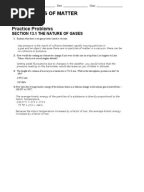
13.1 the nature of gases worksheet
The Nature of Gases 13.1 Flashcards | Quizlet The Nature of Gases 13.1 STUDY Flashcards Learn Write Spell Test PLAY Match Gravity Created by cewilson024 Terms in this set (27) the kinetic theory describes the what? motion of particles in matter and the forces of attraction between them The kinetic theory assumes what? 13.1 The Nature Of Gases Flashcards | Quizlet 13.1 The Nature Of Gases STUDY PLAY kinetic energy the energy object has because of its motion. kinetic theory all matter consists of tiny particles that are in constant motion. gas pressure results from the force exerted by a gas per unit surface area of an object. atmospheric pressure the collisions of atoms and molecules in air with objects. 13.S: Properties of Solutions (Summary) - Chemistry LibreTexts 13.1.1 Energy Changes and Solution Formation. overall enthalpy change in formation of a solution. Δ H s o l n = Δ H 1 + Δ H 2 + Δ H 3. Δ H 1 = separation of solute molecules. Δ H 1 = separation of solvent molecules. Δ H 3 = formation of solute-solvent interactions. separation of solute particles is endothermic.
13.1 the nature of gases worksheet. PDF Chapter 13 Study Guide Gases Answers - ftp.meu.edu.jo chapter 13 study guide gases chapter 13 - gases 195 exercise 13.3 - equation stoichiometry: iron is combined with carbon in a series of reactions to form pig iron, which is about 4.3% carbon. 2c o2 2co fe2o3 3co 2fe 3co2 2co c (in iron) co2 pig iron is easier to shape than pure iron, and the presence of carbon lowers its melting point chapter 13 … CK-12 Chemistry Contents Contents 1 Introduction to Chemistry1 1.1 What is Chemistry?. . . . . . . . . . . . . . . . . . . . . . . . . . . . . . . . . . . . . . . . . 9 PDF Solving Problems: A Chemistry Handbook - Ms. S. Reece solving problems: a 13.1 Nature of Gases Worksheet.pdf - Name Date Class THE... View 13.1 Nature of Gases Worksheet.pdf from CHEMISTRY 163 at Rowad AlKhaleej International Schools, Dammam. Name Date Class THE NATURE OF GASES Section Review Objectives Describe the assumptions of
Chemistry (12th Edition) Chapter 13 - States of Matter - GradeSaver Answer 1)All particles in the liquid should have the kinetic energy that allows them to break the intermolecular forces of attraction and escape. 2)vapor pressure of liquid should be equal or more than the external pressure on the surface of the liquid. Work Step by Step Refer to page 428 the answer to the key question. Update this answer! 15.1.3 Ideal Gas Equation - Save My Exams A storage cylinder of an ideal gas has a volume of 8.3 × 10 3 cm 3. The gas is at a temperature of 15 o C and a pressure of 4.5 × 10 7 Pa. Calculate the amount of gas in the cylinder, in moles. Step 1: Write down the ideal gas equation PDF Chem ID# Name CHAPTER 13 STATE OF MATTER SECTION 13.1 THE NATURE OF GASES SECTION 13.1 THE NATURE OF GASES 1. ... In general, how do the intermolecular attractions between particles in a gas compare with those between particles in a liquid? 2. The normal boiling point of ethanol is 78.5°C. The normal boiling point of water is 100°C. ... Microsoft Word - Ch 13 and 14 Worksheet Author: D. Stevens 13.1 Chemical Equilibria - Chemistry - opentextbc.ca First, the CO 2 gas in the air space on top of the bottle escapes, causing the equilibrium between gas-phase CO 2 and dissolved or aqueous CO 2 to shift, lowering the concentration of CO 2 in the soft drink. Less CO 2 dissolved in the liquid leads to carbonic acid decomposing to dissolved CO 2 and H 2 O.
PDF Chapter 13 - Gases - An Introduction to Chemistry Exercise 13.1 - Using the Ideal Gas Equation: Krypton gas does a better job than argon of slowing the evaporation of the tungsten filament in an incandescent light bulb. Because of its higher cost, however, krypton is used only when longer life is considered to be worth the extra expense. (Objs 15, 16, & 17) a. Carbonates (13.1.1) | CIE IGCSE Chemistry Revision Notes 2020 | Save My ... 13.1.1 Carbonates Download PDF Test Yourself Calcium Oxide & Calcium Carbonate Manufacture of lime Limestone consists mainly of calcium carbonate, CaCO 3 Lime which is calcium oxide, CaO, is manufactured from calcium carbonate by thermal decomposition: CaCO 3 → CaO + CO 2 PDF Chemistry: Matter and Change - Mr. McKnight Clawson High School 13.1 The Gas Laws The Combined Gas Law (cont.) SECTION 13.1 The Gas Laws Boyle's Law explains which relationship of properties in gases? A. pressure and volume B. amount and pressure C. temperature and volume D. volume and temperature SECTION 13.1 Section Check Atoms are in their lowest energy state at what temperature? A. 0° Celsius Honors Chemistry - PLHS Science Lewis Dot Worksheet ... 13.1 The Nature of Gases 13.2 The nature of Liquids ... Chapter 14 - Gases. 14.1 Properties of Gases 14.2 The Gas Laws 14.3 Ideal Gases 14.4 Gases: Mixtures and Movements. Chapter 17 - Thermochemistry. 17.1 The Flow of Energy 17.2 Measuring and Expressing Enthalpy Changes
Chem Section Reviews | Atomic Mass Unit | Ion
PDF CK-12 Chemistry Contents Contents 1 Introduction to Chemistry Assessments1 1.1 What is Chemistry ...
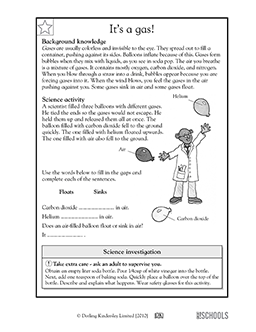
3rd grade, 4th grade Science Worksheets: It's a gas! | GreatSchools
The Nature of Gases 13.1 - Yumpu 13.1 Section Review THE NATURE OF GASES Objectives • Describe the assumptions of the kinetic theory as it applies to gases • Interpret gas pressure in terms of kinetic theory • Define the relationship between Kelvin temperature and average kinetic energy Vocabulary • kinetic energy • kinetic theory • gas pressure Part A Completion

Gases Around Us | Teaching Ideas
Chemistry 13.1 The Nature of Gases Flashcards | Quizlet Theory #1 The particles in a gas are considered to be small, hard sphere with an insignificant volume Theory #2 The motion of the particles in a gas is rapid, constant and random Theory #3 All collisions between particles in a gas are perfectly elastic. gas pressure

35 best Science: Unit 1: Mix, Make, Use! ... images on Pinterest ...
PDF Cambridge IGCSE™ Cambridge IGCSE (9-1) - GCE Guide This scheme of work has been designed to support you in your teaching and lesson planning. Making full use of this scheme of work will help you to improve both your teaching and your learners' potential. It is important to have a scheme of work in place in order for you to guarantee that the syllabus is covered fully.

Gases worksheet 5 worksheet
13.1 The Nature of Gases Flashcards | Quizlet a measure of the force exerted by a gas above a liquid in a sealed container, a dynamic equilibrium exists between the vapor and liquid boiling point the temperature at which the vapor pressure of a liquid is just equal to the external pressure on the liquid. normal boiling point the boiling point of a liquid at a pressure of 101.3 kPa or 1 atm
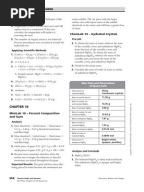
Answer Key
PDF Science Notebook - Teacher Edition - MR. GALLANT'S CLASSES Research-Based Vocabulary Development Third, you will notice that vocabulary is introduced and practiced throughout the Science Notebook.When students know the meaning
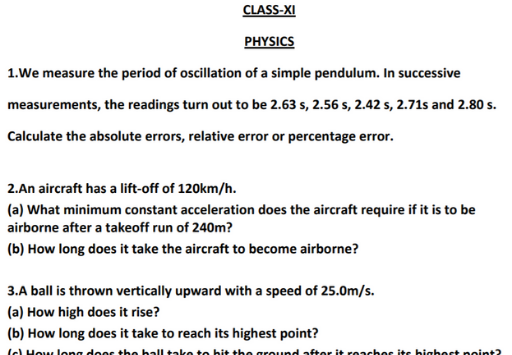
34 13.1 The Nature Of Gases Worksheet - Worksheet Source 2021
13.1 The Nature of Gases | Chemistry - Quizizz 13.1 The Nature of Gases. 0% average accuracy. 0 plays. 8th - 11th grade . ... The motion of the particles in a gas is rapid, constant, and random. answer choices . True.
Chem Section Reviews | Atomic Mass Unit | Ion
PDF Chapter 13- The States of Matter 13.1- The Nature of Gases 13.1- The Nature of Gases Gases- indefinite volume and shape, low density. Kinetic Theory Kinetic theory says that molecules are in constant motion. ... In a closed container the gas molecules will cause pressure. The pressure at equilibrium is called vapor pressure Different compounds have different vapor

Gases Worksheet for 10th - 12th Grade | Lesson Planet
PDF Name Date Class STATES OF MATTER 13 - St. Francis Preparatory School SECTION 13.1 THE NATURE OF GASES (pages 385-389) This section introduces the kinetic theory and describes how it applies to gases. It defines gas pressure and explains how temperature is related to the kinetic energy of the particles of a substance. Kinetic Theory and a Model for Gases (pages 385-386) 1.

Combined Gas Law Lesson Plans & Worksheets | Lesson Planet
SECTION 13.1 THE NATURE OF GASES SECTION 13.2 THE NATURE ... - Me SECTION 13.1 THE NATURE OF GASES 1. Explain why there is no gas pressure inside a vacuum. 2. How would the reading on a barometer change if you were to take one on a trip from Los Angeles to Lake Tahoe, which is at a much higher altitude? 3. The height of a column of mercury in a barometer is 754.3 mm. What is the atmospheric pressure in atm?
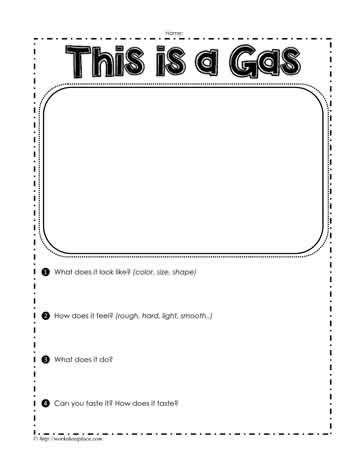
This is a Gas Worksheet Worksheets
Gas Pressure | Chemistry for Non-Majors | | Course Hero Gas pressure is the pressure that results from collisions of gas particles with an object. Inside the balloon, the gas particles collide with the balloon's inner walls. It is those collisions which keep the balloon inflated. If the gas particles were to suddenly stop moving, the balloon would instantly deflate.
PPT - It’s a Gas PowerPoint Presentation, free download - ID:5693199
1.3 Reacting masses and volumes - IB Alchemy Molar volume of a gas. Ideal gas is a gas which follows the kinetic theory of gases. They are found in systems with high temperature and low pressure. Standard Temperature and Pressure (STP): The conditions where temperature is 273K and pressure is 100 kPa. At STP, the Molar Volume of an ideal gas is 22.7 dm 3 mol -1.
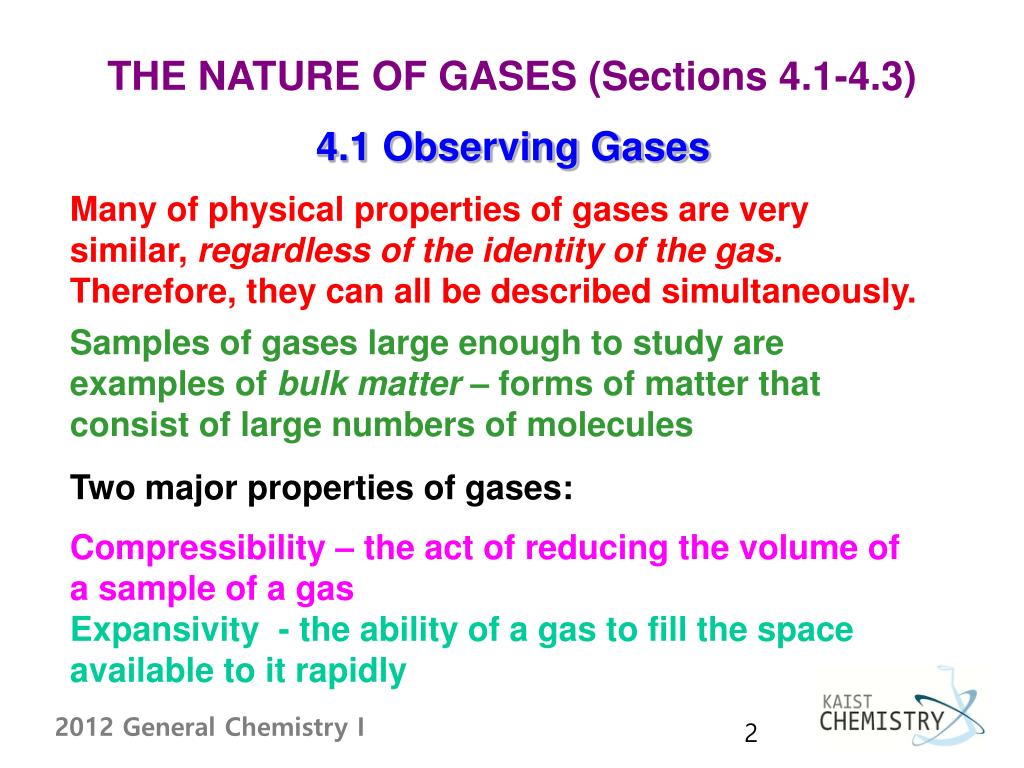
PPT - Chapter 4. THE PROPERTIES OF GASES PowerPoint Presentation, free ...
Chapter 13 ~ Non-Renewable Resources - Environmental Science Canada is one of the world's leading producers of metals, accounting for 15% of the global production of nickel in 2006, 9% of aluminum, and 6% zinc (Tables 13.1 and 13.2). Much metal production is intended for export. Domestic consumption is about 39% of the value of production of all metals (Table 13.2).

Gases. Chemistry Worksheets and Study Guides High School.
CK-12 Chemistry Contents Contents 1 Introduction to Chemistry Worksheets1 1.1 What is Chemistry ...

Behavior Of Gases Worksheet - worksheet
13.1 The nature of gases Flashcards | Quizlet Science Chemistry Atmospheric Chemistry 13.1 The nature of gases STUDY Flashcards Learn Write Spell Test PLAY Match Gravity Kinetic energy Click card to see definition 👆 the energy an object has because of its motion. Click again to see term 👆 1/11

Gases laws worksheets and online exercises
13: Properties of Solutions - Chemistry LibreTexts 13.1: The Solution Process. Solutions are homogeneous mixtures of two or more substances whose components are uniformly distributed on a microscopic scale. The component present in the greatest amount is the solvent, and the components present in lesser amounts are the solute (s). The formation of a solution from a solute and a solvent is a ...
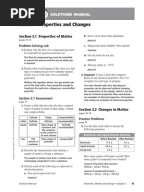
Chem Section Reviews | Atomic Mass Unit | Ion
13.S: Properties of Solutions (Summary) - Chemistry LibreTexts 13.1.1 Energy Changes and Solution Formation. overall enthalpy change in formation of a solution. Δ H s o l n = Δ H 1 + Δ H 2 + Δ H 3. Δ H 1 = separation of solute molecules. Δ H 1 = separation of solvent molecules. Δ H 3 = formation of solute-solvent interactions. separation of solute particles is endothermic.
0 Response to "42 13.1 the nature of gases worksheet"
Post a Comment